How to dehydrate fresh cranberries without expecting Craisins
Fresh cranberries arrive with a skin built to hold water in. A reliable drying batch opens that barrier, gives every berry room for airflow, judges the cooled center instead of the clock, and accepts that unsweetened home-dried fruit will be tart and firm.
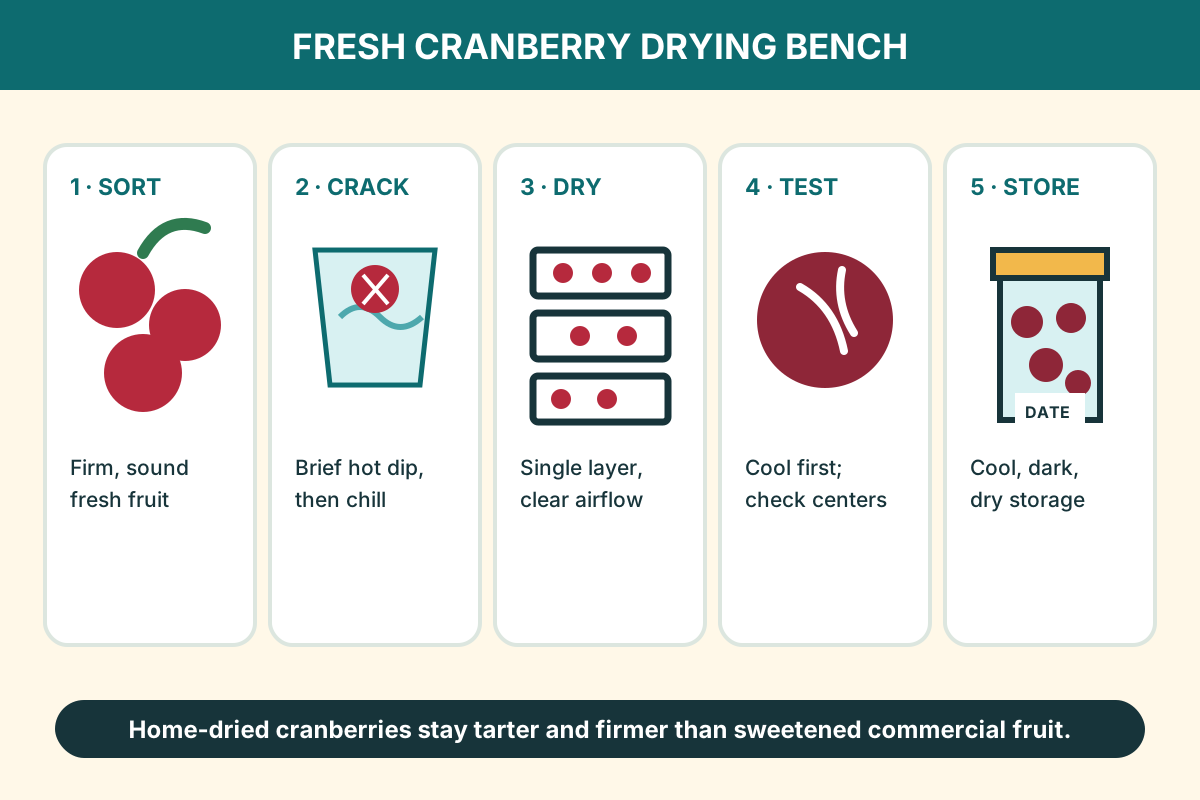
The measured cranberry batch
- Sort firm, sound fresh cranberries; wash and drain them.
- Briefly dip berries in boiling water until skins crack, then chill and blot dry.
- Arrange one layer on mesh-lined dehydrator trays with room for airflow.
- Follow one complete Extension method and your appliance manual; test cooled berries for hidden moisture.
- Condition, package in small amounts, label, and store cool, dry, and dark.
Cranberry season runs through the weeks when people plan holiday baking, oatmeal, trail mix, and edible gifts. That creates a predictable question: can a bag of fresh berries become the soft, sweet dried cranberries sold beside raisins? Drying can preserve cranberries, but the home result is different. Penn State Extension specifically notes that home-dehydrated berries are not like commercial sweetened dried cranberries. The gap matters because a cook who aims for commercial softness may stop a home batch while moisture remains inside.
The useful target is a safely dried, intensely tart ingredient. It can go into oatmeal, quick breads, granola, pilaf, stuffing, sauces, and simmered compotes. It can be sweetened when used in a recipe, where the sugar and liquid are controlled. That is a more honest goal than trying to reverse-engineer a branded product without its process.
Why whole cranberries resist drying
A cranberry's smooth outer layer protects the fruit. Utah State University Extension groups cranberries with prunes, plums, blueberries, and grapes that have a natural wax coating. If these fruits are dried whole, the guidance calls for “crazing” the skin with a brief hot-water treatment so moisture can escape. Penn State likewise directs home dryers to dip cranberries in boiling water to crack the skins, chill them quickly, and blot them dry.
Skipping that step can produce a deceptive berry: the surface wrinkles while the interior remains wet, or the batch takes so long that quality suffers. Cutting every berry is tedious and inconsistent, while crushing them changes the form entirely. A controlled skin-cracking step keeps the fruit whole enough for later use while creating paths for moisture to leave.
Start with fruit worth preserving
Use firm, sound berries with no mold, fermentation odor, or soft leaking areas. Sorting after drying is too late; dehydration does not make spoiled food sound again. Rinse the cranberries under cool running water and remove stems or plant debris. Drain them before the hot-water step.
Run one bag or one measured weight as a batch and record it. Cranberry size varies, and large berries often finish after small ones. Recording the fresh weight, tray count, and finished weight helps explain yield and lets you estimate how many fresh bags are needed for a future recipe.
Keep fresh and frozen fruit as separate trials. Freezing ruptures cell structure and can change both drying speed and final texture. If you test frozen cranberries, label that experiment clearly and follow an Extension method that addresses the preparation you are using rather than assuming the fresh schedule transfers unchanged.
Crack the skins, chill, and remove surface water
Bring enough water to a boil that the berries can move freely. Add only a manageable amount. Watch for skins to split; then remove the berries promptly and transfer them to cold water. Utah State's general home-drying guidance describes a 15-to-60-second hot-water dip depending on fruit size and skin toughness, followed immediately by cold water. Penn State tells cranberry dryers to stop when the skins crack rather than relying on one universal time.
Drain the chilled berries well and blot the outside. Water clinging to the surface must evaporate before the dehydrator can begin removing water from the fruit. A salad spinner used gently can help with the first drain, but blotting on clean towels is easier on split skins.
Some guides and public discussions suggest sugar, syrup, freezing, squeezing, or cutting after the hot-water step. These choices change sweetness, stickiness, drying behavior, and intended storage. If you choose a sweetened method from an authoritative source, follow its entire formula and label the addition rather than scattering sugar over a batch by guesswork.
Load for airflow instead of maximum tray count
Place the drained cranberries in one layer. A flexible mesh liner helps keep small berries from falling through wide tray openings, but it should be designed for the appliance and should not block circulation. Separate touching berries where practical. Do not pile them to save a tray.
Home food drying depends on low heat, low humidity, and moving air. The University of Minnesota Extension explains that drying time changes with food type, thickness, moisture content, and method. Cranberry size, the number of skins that actually cracked, room humidity, and tray loading all add variation. A timer is a reminder to inspect rather than a declaration that the food is done.
Follow the temperature and operating instructions in the complete current Extension process you select and the manual for your dehydrator. Do not turn the thermostat above the tested method to force a deadline. Too much heat can dry the outside faster than the center and create case hardening. Keep vents clear, confirm that the fan is operating, and rotate trays only if the maker recommends it.
Use cooled berries to judge the finish
Begin checking the smallest berries first. Remove several samples from different trays and let them cool completely. Warm fruit can feel soft in a way that changes after cooling, and a wrinkled exterior does not reveal the center. Cut or press the largest samples and look closely for a wet pocket. Return uncertain berries to the dryer.
Source descriptions differ because methods and intended results differ. Utah State's cranberry recipe describes chewy fruit with no pockets of moisture, while broader National Center fruit guidance says berries may be dried until they rattle when shaken. Do not splice the easiest parts of two methods together. Choose one complete current method and follow its preparation, temperature, and finish test as a set. The shared principle is that visible or squeezable interior moisture is not a finished product.
Sort by finish if needed. A small berry that is done should not remain in the machine while the largest berries continue for hours. Note which tray positions lag. That observation may reveal crowding or uneven airflow worth correcting on the next run.
Still wet
A cut berry shows a glossy pocket, squeezes out moisture, or feels cool and soft in the center. Return it to the dryer.
Ready to condition
Cooled berries meet the complete method's texture test and have no visible or squeezable interior moisture.
Questionable
Off odor, mold, or fermentation is a discard signal. Drying is not a salvage step for spoiled fruit.
Condition the batch before pantry storage
Pieces from one tray rarely contain exactly the same amount of remaining moisture. Conditioning lets that moisture equalize and makes a damp outlier easier to find. After the cranberries cool, loosely pack them in clean, dry glass or food-safe plastic containers. Fill each about two-thirds full, close it, and keep it where you will remember to inspect it.
For seven to ten days, shake the containers daily so pieces separate and examine the inside for condensation. If moisture appears, return the fruit to the dryer, retest it after cooling, and restart conditioning. Discard any moldy batch. The site's dried-fruit conditioning guide provides a simple jar routine.
Conditioning does not replace drying. Wet fruit should never be sealed with the idea that moisture will somehow disappear. The process only redistributes small differences between pieces that already passed a validated finish test.
Package for humidity control and realistic use
When conditioning is complete, divide the cranberries among clean, dry, moisture-resistant packages. Small packages protect the rest of the batch from humid kitchen air each time you open one. Label the fresh weight, skin treatment, drying dates, conditioning dates, finished weight, and any sweetener used.
Store packages in a cool, dry, dark place. The University of Minnesota Extension gives a broad quality range of four to twelve months for dried foods depending on storage conditions and recommends temperatures below 60°F for best quality. Utah State's berry guidance says dried products may keep about a year when sealed in moisture-proof containers and kept cool, dark, and dry. These ranges assume the product was fully dried and properly packaged; a calendar cannot compensate for trapped moisture.
Check packages periodically. Condensation, mold, fermentation, or an off odor means the fruit should not be tasted. A clean batch that merely softens after exposure to humidity needs prompt use or redrying under source guidance, followed by cooling and another conditioning check.
Plan a kitchen role for tart berries
| Use | How to plan it | What to record |
|---|---|---|
| Oatmeal or porridge | Simmer berries with the grain so they rehydrate and soften. | Liquid added and cooking time |
| Quick bread or muffins | Use a recipe written for dried fruit; chopped berries spread tartness. | Weight used and whether rehydrated |
| Granola or trail mix | Combine only after every ingredient is cool and dry. | Batch date and package size |
| Pilaf or stuffing | Add with enough cooking liquid to soften the fruit. | Liquid ratio and finished texture |
| Compote or sauce | Rehydrate during cooking and sweeten the whole recipe to taste. | Water, sweetener, and yield |
Home-dried cranberries may be too tart or firm for straight snacking, especially without sweetener. That does not make the batch a failure. A concentrated ingredient can be more useful than a copy of a store snack.
Avoid four common dead ends
- Drying intact skins. The protective coating slows moisture loss and makes the center hard to judge.
- Boiling until soft. The skin step is brief; cooking the center produces mush and an uneven tray.
- Using commercial softness as the endpoint. Sweetened commercial dried cranberries are produced differently. A moist homemade imitation is not ready for pantry storage.
- Grinding a flexible batch. Powder needs fruit dry enough to grind cleanly and storage that protects it from humidity.
Keep one batch note for next season
Record the variety or package source, fresh weight, berry size range, hot-water step, tray count, dehydrator model, setting from the chosen method, start and finish times, tray rotations, cooled endpoint, final weight, conditioning observations, and storage location. Add one use test, such as the amount that worked in oatmeal. Next autumn, that page will be more helpful than a viral drying-time promise.
Sources and review notes
This guide was researched and reviewed October 28, 2026. Preparation, skin cracking, drying principles, conditioning, storage, and seasonal context were checked against:
- Penn State Extension — Let's Preserve: Drying Fruits and Vegetables.
- Penn State Extension — Cranberry Season.
- Utah State University Extension — Home Drying Foods.
- University of Minnesota Extension — Preserving Food at Home: Drying.
- National Center for Home Food Preservation — Packaging and Storing Dried Foods.
Public discussions were reviewed for recurring questions about popping skins, sweetening, frozen berries, drying times, and commercial texture. Instructions were resolved against Extension and NCHFP guidance rather than anecdotes. Follow the complete current source method and the appliance manual.