How to dehydrate mushrooms for slices or powder
A good mushroom batch begins with a source decision, not a temperature. Use cultivated edible mushrooms from a reputable grower or grocer, clean them just before processing, control the cut, follow one complete Extension method, and decide whether you want rehydratable pieces or a fully brittle powder ingredient.
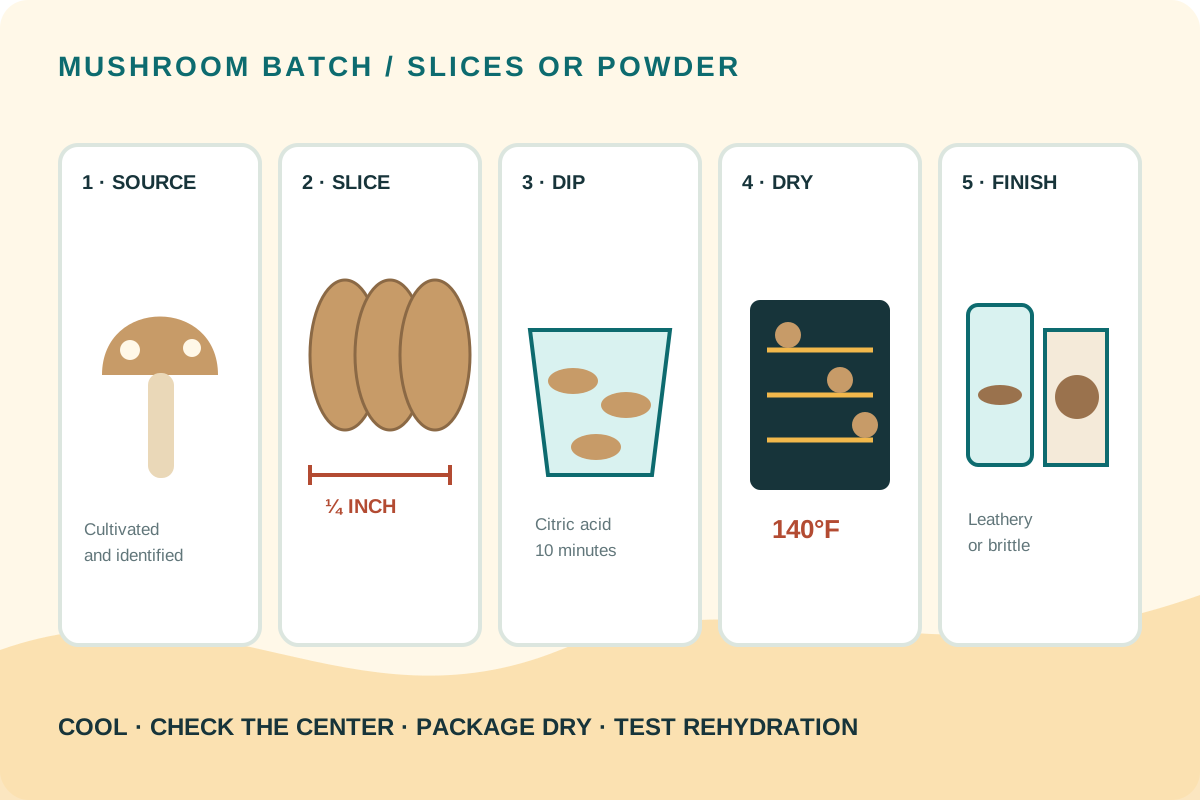
The measured mushroom batch
- Buy firm, unblemished cultivated mushrooms and reject mold, slime, decay, or an uncertain identity.
- Clean immediately before drying; trim tough stem ends and make a uniform cut.
- For the CSU Extension method, dip for 10 minutes in 1 teaspoon citric acid per quart of water, then drain well.
- Load one loose layer and dry at 140°F, following the dehydrator manual.
- Begin checking before the end of the 8–12 hour Extension range and judge cooled pieces, not warm ones.
- Package slices only when dry and leathery; dry powder pieces until brittle enough to break cleanly.
Start with cultivated mushrooms and a planned use
Utah State University Extension recommends buying mushrooms from a reputable grower or grocer because a mistaken identification can cause serious illness or death. Colorado State University Extension gives the same warning in its drying guide: only an expert can distinguish poisonous from edible wild varieties, and toxins are not destroyed by drying or cooking.
Choose firm mushrooms with unblemished caps, no visible mold, and no wet or slimy surface. White button, cremini, portobello, and cultivated shiitake are practical grocery-store candidates, but their shapes and stems behave differently. Thick portobello flesh needs a controlled slice; shiitake stems are often too woody for a pleasant rehydrated piece but can be dried separately for powder if sound and clean.
Decide on the destination before opening the package. Slices suit soups, braises, rice, and broth. Powder suits sauces, gravies, seasoning blends, and recipes where mushroom flavor is useful but a chewy rehydrated texture is not. Recent public cooking discussions repeatedly ask why dried pieces stay rubbery and what to do with tough stems. That makes “slices or powder?” a useful batch decision, not an afterthought.
Clean them just before the tray
Wash hands and clean the knife, board, trays, and work surface. FDA guidance says to rinse produce under running water and not to use soap, detergent, or commercial produce wash. USU’s mushroom guidance allows a rinse under cold running water or a gentle wipe with a damp cloth, paper towel, or soft brush. Clean only when you are ready to process, then pat the mushrooms dry.
Trim the dry or discolored end of each stem. Discard tough, woody sections from the slice batch. Do not attempt to save a mushroom with mold, a rotten smell, leaking decay, or deep damage by cutting around it for dehydration. Drying removes moisture; it is not a repair step for spoiled produce.
Choose one cut and measure it
Colorado State’s method directs the dryer to leave small mushrooms whole, peel and slice large mushrooms, and cut tender stalks into short sections. For a first batch, uniform slices are easier to judge than mixed whole caps, thick quarters, and thin stem coins. A quarter-inch cut is a useful control point for tender stems and larger caps; separate very small whole mushrooms because they will not finish on the same clock.
| Piece | Best batch destination | Control to record |
|---|---|---|
| ¼-inch cap slices | Rehydrating for soups, rice, sauces, or braises | Species or label, average thickness, tray position |
| Small whole cultivated mushrooms | Whole-piece use after a longer drying and rehydration test | Average diameter and a separate finish time |
| Tender stem sections | Broth or powder | Keep separate from cap slices |
| Tough sound stems | Powder only if they dry brittle and mill cleanly | Separate tray and labeled jar |
Do not use a single finish time for all four. Surface area and thickness control how far moisture must travel. The goal is a comparable batch, not a full dehydrator with every mushroom shape mixed together.
Use a complete pretreatment, not a borrowed shortcut
The Colorado State University Extension table uses no blanching step for mushrooms. It calls for a 10-minute dip in a solution of 1 teaspoon citric acid per quart of water, followed by draining. Citric acid is the ingredient and proportion in that method; lemon juice and vinegar are not automatically equivalent substitutions.
Extension tables can differ because they describe different equipment, cuts, and complete methods. Do not combine the shortest time from one table, a different temperature from a second, and an improvised dip from a video. For this batch, keep the CSU sequence together: cultivated mushrooms, preparation as specified, citric-acid dip, 140°F drying, and the stated dryness check.
Load for airflow and dry at 140°F
Preheat the dehydrator and follow its manual for tray liners, load size, spacing, and tray rotation. Drain the pretreatment well and blot excess surface moisture. Arrange pieces in one loose layer without overlap. Air must move around the food; a piled tray creates damp contact points and uneven drying.
Set the dehydrator to 140°F. Colorado State estimates 8–12 hours for its mushroom method and defines the finish as dry and leathery. Treat that range as a time to inspect, not a guarantee. Variety, whole versus sliced pieces, room humidity, surface water, load, tray position, airflow, and thermostat accuracy can all move the endpoint.
Dry continuously. If your machine dries unevenly, rotate trays only as the manual directs. Remove fully dried pieces and return thicker ones to the machine instead of forcing thin pieces to wait for a whole cap. Record every removal time.
Cool it
Let a representative thick piece return to room temperature. Warm food can feel softer and hide the true finish.
Cut it
Split the center. There should be no cool, glossy, or damp pocket and no moisture when pressed.
Match the use
Slices can be dry and leathery. Pieces for powder should be brittle enough to snap and mill without smearing.
Do not confuse leathery slices with powder-ready pieces
For stored slices, follow the method’s “dry and leathery” endpoint and verify several pieces from different trays. For powder, continue drying a separate portion until pieces break cleanly. A bendy piece can smear in a grinder and leave a damp powder that cakes in storage.
Cool pieces completely before grinding. Mill small batches in equipment intended for dry foods and follow its capacity and ventilation instructions. Fine mushroom dust can become airborne; keep the lid closed, let dust settle before opening, and avoid breathing the powder. If the mill warms the powder, spread it on a clean tray to cool before packaging. Do not add salt, oil, or other ingredients to the storage jar; blend seasonings when you cook.
Mushroom batch and rehydration record
Use one record per mushroom type, cut, and finish target. The rehydration note tells you whether the next batch should remain slices or become powder.
Cool, package, and watch for moisture
Cool the dried mushrooms completely before packaging. The National Center for Home Food Preservation warns that warm food can sweat inside a container and create enough moisture for mold. Pack in clean, dry, airtight, moisture-resistant containers. Small recipe-size portions reduce the number of times the main batch is exposed to humid room air.
Label the cultivated mushroom type, source, cut, pretreatment, drying date, finish target, and dry weight. Store in a cool, dry, dark place. Glass is useful because moisture is visible. Check the package frequently at first and again during storage. If food has absorbed moisture but shows no spoilage, redry and repackage it. Discard moldy food rather than smelling closely, tasting, or sorting around the affected pieces.
Vegetables do not use the 7–10 day fruit-conditioning procedure. The practical control is complete drying, immediate moisture-proof packaging, and inspection for condensation or softening. Powder is especially quick to show a problem: clumps that do not break apart, damp streaks, or condensation mean the package needs attention.
Rehydrate with time, liquid, and refrigeration
USU’s dried-food guidance says most vegetables can be covered with water until rehydrated, added to hot or boiling water, or placed directly in a liquid-rich soup or stew. Rehydration commonly takes one to two hours, depending on the food, thickness, age, and water temperature. If soaking takes more than two hours or continues overnight, refrigerate it.
Use only enough liquid to keep the pieces covered. Cook rehydrated mushrooms in the finished dish and treat them as perishable once water returns. A soaking liquid can carry useful flavor, but it can also carry grit. Pour it through a fine filter if you plan to cook with it. If the rehydrated slices remain unacceptably chewy after adequate soaking and cooking, record that result and convert the remaining dry batch to powder rather than repeating the same texture disappointment.
Powder does not need a separate soaking session when it is stirred into a sufficiently liquid cooked dish. Start with a small amount, let it hydrate and cook, then adjust. It is concentrated by volume compared with fresh mushrooms, and a home batch has no universal one-to-one substitution.
Keep the method inside its lane
This guide does not cover wild mushrooms, psychoactive mushrooms, medicinal claims, raw shelf-stable mushroom sauces, or oil-packed dried mushrooms. Adding dried vegetables to oil changes the food-safety problem; use a tested refrigerated recipe from a reliable source rather than improvising a pantry product.
Dehydration and freeze-drying are also different processes. The dehydrator versus freeze-dryer guide explains the equipment, texture, and storage tradeoffs. For universal packing habits, review why fruit conditioning is a separate process, and use the fresh-herb guide for a lower-temperature crop.
Questions that change the batch
Can I dehydrate mushrooms I foraged?
Not from this guide. Drying and cooking do not neutralize poisonous mushroom toxins, and visual similarity can be dangerous. Use cultivated edible mushrooms from a reputable commercial source unless identification was made by a qualified local expert and you have a research-based method for that exact species.
Should I wash mushrooms or only brush them?
FDA says produce should be washed under running water without soap. USU says mushrooms may be rinsed under cold running water or gently wiped with a damp cloth, towel, or soft brush. Clean immediately before processing, avoid soaking, and remove surface water before the pretreatment.
Why are my dried mushrooms still chewy after soaking?
Species, stem toughness, slice thickness, storage age, and rehydration method all affect texture. Dried mushrooms will not necessarily return to fresh texture. Record the result; use the pieces in long-cooked liquid dishes or dry them fully and turn them into powder.
How long do mushrooms take in a dehydrator?
Colorado State estimates 8–12 hours for its method. That is an inspection range. The cooled center and intended finish—leathery slice or brittle powder piece—decide when the batch is done.
Primary sources and research notes
- Colorado State University Extension — Drying Vegetables — poisonous-mushroom warning, mushroom preparation, citric-acid dip, drying range, and dry/leathery endpoint.
- Utah State University Extension — Fruit and Vegetable Guide Series: Mushrooms — reputable sourcing, selection, refrigerated holding, and cleaning.
- U.S. Food and Drug Administration — Selecting and Serving Produce Safely — refrigeration, clean handling, running-water washing, and no soap or produce wash.
- National Center for Home Food Preservation — Packaging and Storing Dried Foods — cooling, moisture-proof packaging, storage, inspection, and mold response.
- Utah State University Extension — Food Storage in the Home — rehydrating dried vegetables, refrigeration after two hours, cooking uses, and soaking liquid.
Reader-question check: public cooking and dehydrating discussions repeatedly ask about rubbery rehydrated pieces, mushroom powder, tough stems, clumping, and uses for soaking liquid. Those questions shaped the decision points above; the preservation method and safety limits come from FDA, NCHFP, and Extension sources. Reviewed November 16, 2026.